Content patterns
PageIntro · SectionHead
About
Career
How I work, where I have worked and what came of it.
Experience
The roles, my responsibility and the products behind them.
Usage and source contract
Reuse this composition from its source and demo. Keep its existing semantic structure and locale/data contracts.
Primary source: src/components/PageIntro.astro
src/components/SectionHead.astro
States: default · keyboard focus where interactive · light / dark · reduced motion
- Use native semantics and visible keyboard focus.
- Check 320px, long content and both themes.
<PageIntro as="h2" kicker={t(locale, 'intro.kicker')} title={t(locale, 'intro.title')} lead={t(locale, 'intro.lead')} />
  <SectionHead as="h3" title={t(locale, 'section.title')} lead={t(locale, 'section.lead')} />
FactGrid
- Experience
- 11+ years
- Team
- 4 → 14
- Design systems
- since 2017
- Focus
- AI · Systems
Usage and source contract
Reuse this composition from its source and demo. Keep its existing semantic structure and locale/data contracts.
Primary source: src/components/FactGrid.astro
States: default · keyboard focus where interactive · light / dark · reduced motion
- Use native semantics and visible keyboard focus.
- Check 320px, long content and both themes.
<FactGrid items={([1, 2, 3, 4] as const).map((n) => ({k: t(locale, `fact.${n}.k`), v: t(locale, `fact.${n}.v`)}))} />FileCard
Usage and source contract
Reuse this composition from its source and demo. Keep its existing semantic structure and locale/data contracts.
Primary source: src/components/FileCard.astro
src/components/Grid.astro
States: default · keyboard focus where interactive · light / dark · reduced motion
- Use native semantics and visible keyboard focus.
- Check 320px, long content and both themes.
<Grid cols={2}>
    <FileCard href={t(locale, 'nav.cvHref')} title={t(locale, 'file.cvTitle')} meta={t(locale, 'file.cvMeta')} />
    <FileCard href={t(locale, 'file.cvWordHref')} title={t(locale, 'file.cvTitle')} meta={t(locale, 'file.cvWordMeta')} icon="file" />
  </Grid>
ContactBlock
Let’s talk about the work.
Looking for someone to shape a complex product, lead a design team or build shared foundations? Get in touch.
max@does.systemsExplore the workUsage and source contract
Reuse this composition from its source and demo. Keep its existing semantic structure and locale/data contracts.
Primary source: src/components/ContactBlock.astro
States: default · keyboard focus where interactive · light / dark · reduced motion
- Use native semantics and visible keyboard focus.
- Check 320px, long content and both themes.
<ContactBlock locale={locale} />Case components
zvoove · Platform Experience & AI
From individual products to one shared platform.
I designed Launchpad, zAIn and Notification Center as one AI-enriched platform experience — from strategy to the production frontend, with reusable foundations for Product and Engineering.
- Role in the project
- Sole designerAcross teams · zvoove Germany
- Collaboration
- PMs, dev leads & EngineeringFeature teams in trios
- Responsibility
- Strategy to design engineeringResearch · AI experience · Design system
- As of September 2026
- Launchpad · zAIn · Notification Center
Live since August 2026+3
As of September 2026
Live
Since August 2026: Launchpad, zAIn, Notification Center · 16 cloud customers, 12 active
Limited
48 write endpoints behind the human gate, not shipped
Proof
Action Center and Decision Card, not shipped yet
Not measured
Impact: no before-and-after comparison
Case notes
- Evidence
My own case documentation for both projects and a letter of recommendation.
- Images
All screens show demo data. The warning levels are a schematic rebuild.
- Team effort
Financial results come from joint initiatives.
- Last updated
October 2026
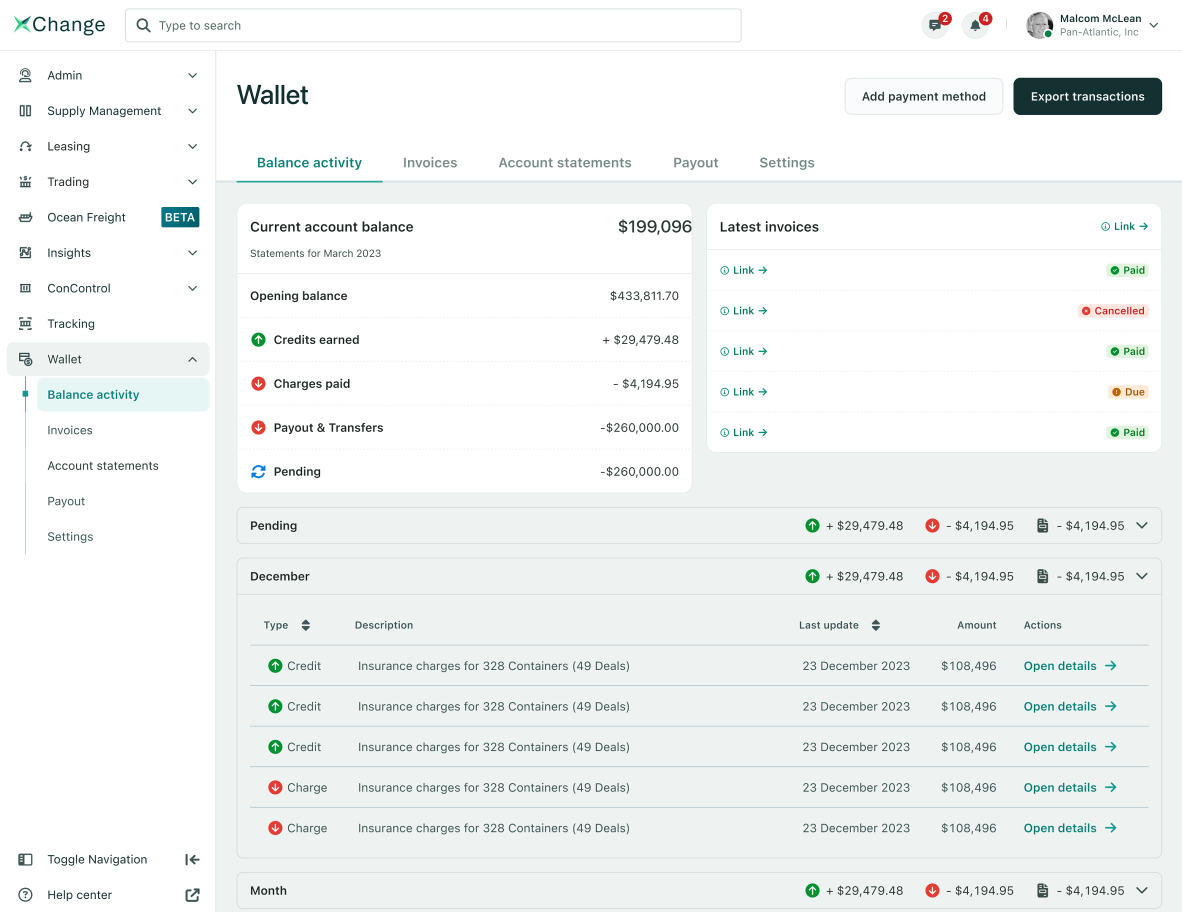
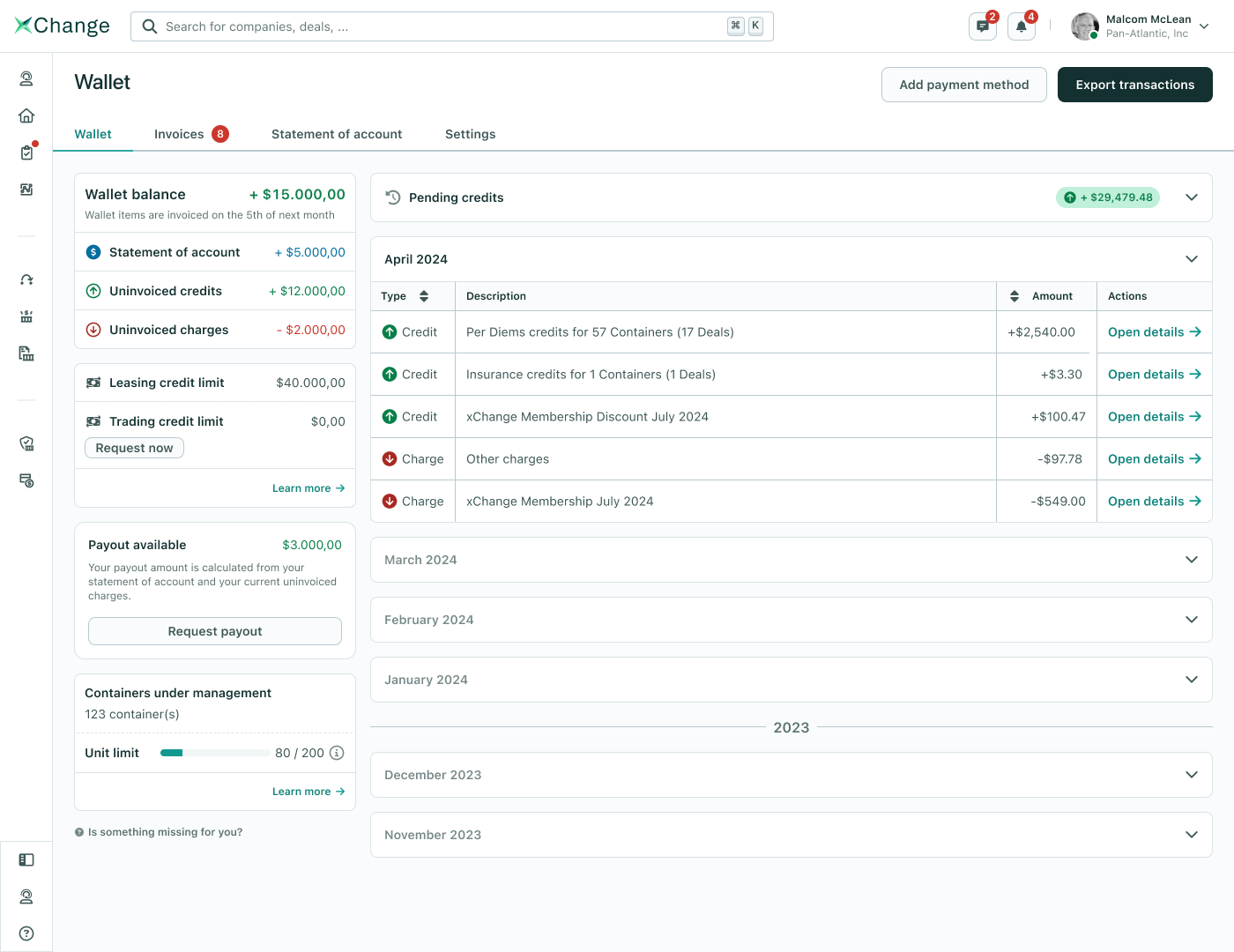
Container xChange is a B2B marketplace for shipping containers. Its wallet brought together credits, income, invoices and credit limits, and every month 150–200 support requests came in about not understanding it. As Lead Designer, I reorganised the financial overview and connected payments to risk limits across two projects.
Usage and source contract
Reuse this composition from its source and demo. Keep its existing semantic structure and locale/data contracts.
Primary source: src/components/ds/CaseDemos.astro
src/components/case/CaseHero.astro
src/components/case/CaseNotes.astro
src/components/case/CaseRail.astro
src/components/case/CaseText.astro
States: default · keyboard focus where interactive · light / dark · reduced motion
- Use native semantics and visible keyboard focus.
- Check 320px, long content and both themes.
<CaseHero content={cases[1]} locale={locale} demo/>
 <CaseRail content={finance} readTime={'8 '+t(locale,'case.minutes')} demo/>
 <CaseNotes notes={finance.notes} locale={locale}/>
 <CaseText locale={locale} text={finance.hero.lead}/>
p
More than 20 interviews and hundreds of support calls showed the same pattern: users did not understand their invoices or the categories and statuses of their transactions. Balances and open amounts were hard to follow, and there were no direct payment actions.
Usage and source contract
Data-driven case block. Read src/lib/case-schema.ts and docs/case-playbook.md; examples are rendered from existing approved case data, never author facts here.
Primary source: src/components/case/CaseBlock.astro
Variants: p
States: default · light / dark · reduced motion
- Preserve heading order, evidence captions and publication rules.
<CaseBlock block={block} caseId={caseId} locale={locale} />callout
Usage and source contract
Data-driven case block. Read src/lib/case-schema.ts and docs/case-playbook.md; examples are rendered from existing approved case data, never author facts here.
Primary source: src/components/case/CaseBlock.astro
Variants: callout
States: default · light / dark · reduced motion
- Preserve heading order, evidence captions and publication rules.
<CaseBlock block={block} caseId={caseId} locale={locale} />h3
The overview beside the details
Usage and source contract
Data-driven case block. Read src/lib/case-schema.ts and docs/case-playbook.md; examples are rendered from existing approved case data, never author facts here.
Primary source: src/components/case/CaseBlock.astro
Variants: h3
States: default · light / dark · reduced motion
- Preserve heading order, evidence captions and publication rules.
<CaseBlock block={block} caseId={caseId} locale={locale} />pair
Usage and source contract
Data-driven case block. Read src/lib/case-schema.ts and docs/case-playbook.md; examples are rendered from existing approved case data, never author facts here.
Primary source: src/components/case/CaseBlock.astro
Variants: pair
States: default · light / dark · reduced motion
- Preserve heading order, evidence captions and publication rules.
<CaseBlock block={block} caseId={caseId} locale={locale} />goals
- Finance support requestsGoal: −15%
- around −80%Goal exceeded
- Wallet payoutsGoal: +20%
- +72%Goal exceeded
Usage and source contract
Data-driven case block. Read src/lib/case-schema.ts and docs/case-playbook.md; examples are rendered from existing approved case data, never author facts here.
Primary source: src/components/case/CaseBlock.astro
Variants: goals
States: default · light / dark · reduced motion
- Preserve heading order, evidence captions and publication rules.
<CaseBlock block={block} caseId={caseId} locale={locale} />learn
Usage and source contract
Data-driven case block. Read src/lib/case-schema.ts and docs/case-playbook.md; examples are rendered from existing approved case data, never author facts here.
Primary source: src/components/case/CaseBlock.astro
Variants: learn
States: default · light / dark · reduced motion
- Preserve heading order, evidence captions and publication rules.
<CaseBlock block={block} caseId={caseId} locale={locale} />levels
Level 1 · Notice
Dismissible. Points to open invoices and the credit limit.
Level 2 · Payment request
Stays in place, with restrictions until payment.
Usage and source contract
Data-driven case block. Read src/lib/case-schema.ts and docs/case-playbook.md; examples are rendered from existing approved case data, never author facts here.
Primary source: src/components/case/CaseBlock.astro
Variants: levels
States: default · light / dark · reduced motion
- Preserve heading order, evidence captions and publication rules.
<CaseBlock block={block} caseId={caseId} locale={locale} />figure
Usage and source contract
Data-driven case block. Read src/lib/case-schema.ts and docs/case-playbook.md; examples are rendered from existing approved case data, never author facts here.
Primary source: src/components/case/CaseBlock.astro
Variants: figure
States: default · light / dark · reduced motion
- Preserve heading order, evidence captions and publication rules.
<CaseBlock block={block} caseId={caseId} locale={locale} />quote
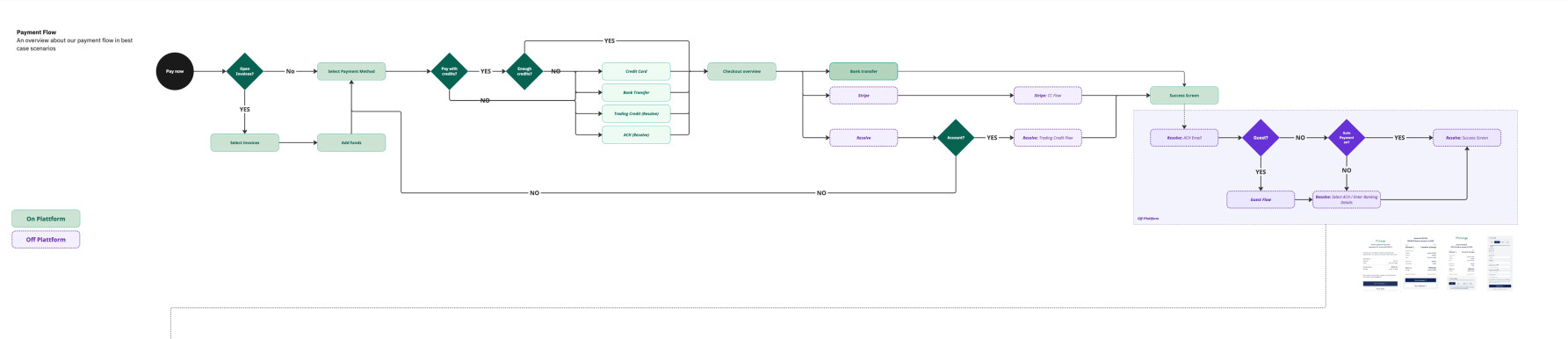
Wallet 1.5 was meant as a stopgap and became the foundation for 2.0. Credit Limit reduced financial risk quickly and created building blocks that carried further payment flows.
Usage and source contract
Data-driven case block. Read src/lib/case-schema.ts and docs/case-playbook.md; examples are rendered from existing approved case data, never author facts here.
Primary source: src/components/case/CaseBlock.astro
Variants: quote
States: default · light / dark · reduced motion
- Preserve heading order, evidence captions and publication rules.
<CaseBlock block={block} caseId={caseId} locale={locale} />list
A smaller stakeholder group
Too many participants slowed Credit Limit down. A more selective group would have been faster.
Protect focus
Wallet 1.5 could have shipped in half the time. Side projects with higher priority stretched the plan.
Refine earlier
The first warning UI needed adjustments after launch to become clearer.
Usage and source contract
Data-driven case block. Read src/lib/case-schema.ts and docs/case-playbook.md; examples are rendered from existing approved case data, never author facts here.
Primary source: src/components/case/CaseBlock.astro
Variants: list
States: default · light / dark · reduced motion
- Preserve heading order, evidence captions and publication rules.
<CaseBlock block={block} caseId={caseId} locale={locale} />model-columns
December 2025
Small team · personal oversight
The classic overview is seen as unhelpful day to day — with a manageable team size you already know the situation. What matters is fast access to a single fact.
Chat · priority 1 · Dashboard · lowDecember 2025 · one day later
Larger operation · Expert Mode
Chat is rated “nice to have, but not essential”. The dashboard, by contrast, replaces the laborious search inside Expert Mode and is seen as the real gain.
Chat · nice to have · Dashboard · priority 1
Usage and source contract
Data-driven case block. Read src/lib/case-schema.ts and docs/case-playbook.md; examples are rendered from existing approved case data, never author facts here.
Primary source: src/components/case/CaseBlock.astro
Variants: model-columns
States: default · light / dark · reduced motion
- Preserve heading order, evidence captions and publication rules.
<CaseBlock block={block} caseId={caseId} locale={locale} />facts
Research in numbers
~20
zAIn interviews, together with the PM
9
interviews on the Safety Manager, 5 external, 4 internal
2
customer shadowing sessions
11
participants in the discovery workshop
3
customers in the validation track
4
personas from the user insights synthesis
Usage and source contract
Data-driven case block. Read src/lib/case-schema.ts and docs/case-playbook.md; examples are rendered from existing approved case data, never author facts here.
Primary source: src/components/case/CaseBlock.astro
Variants: facts
States: default · light / dark · reduced motion
- Preserve heading order, evidence captions and publication rules.
<CaseBlock block={block} caseId={caseId} locale={locale} />timeline
Further stops: Research Hub (July 2025), Safety Manager interviews, internal interviews with customer support, sales, key account and product, Master Unified Entry Experience, zCom, validation track with three customers.
Usage and source contract
Data-driven case block. Read src/lib/case-schema.ts and docs/case-playbook.md; examples are rendered from existing approved case data, never author facts here.
Primary source: src/components/case/CaseBlock.astro
Variants: timeline
States: default · light / dark · reduced motion
- Preserve heading order, evidence captions and publication rules.
<CaseBlock block={block} caseId={caseId} locale={locale} />model-converge
Dispatch
- Sick notes via WhatsApp, calls or SMS, typed into the ERP by hand
- context switches between ERP, phone, email and WhatsApp
Payroll and admin
- statutory deadlines without proactive warnings
- missing and faulty timesheets at the start of the month
Branch management
- figures only through manual reports
- no early warning on negative trends
Recruiting
- applications across many channels without a central view
- documents and work permits checked by hand
Shared pattern
All four roles reconstruct the case themselves before they can decide.
Usage and source contract
Data-driven case block. Read src/lib/case-schema.ts and docs/case-playbook.md; examples are rendered from existing approved case data, never author facts here.
Primary source: src/components/case/CaseBlock.astro
Variants: model-converge
States: default · light / dark · reduced motion
- Preserve heading order, evidence captions and publication rules.
<CaseBlock block={block} caseId={caseId} locale={locale} />quotes
“If zvoove’s future product world looks LIKE THIS … it would be the first time in years that I’d even open a zvoove product again!”
“We really need an AI chat like this that knows the zvoove context. It makes a lot easier.”
Usage and source contract
Data-driven case block. Read src/lib/case-schema.ts and docs/case-playbook.md; examples are rendered from existing approved case data, never author facts here.
Primary source: src/components/case/CaseBlock.astro
Variants: quotes
States: default · light / dark · reduced motion
- Preserve heading order, evidence captions and publication rules.
<CaseBlock block={block} caseId={caseId} locale={locale} />jobs
The four jobs to be done we identified share one core: understand the case before deciding, without piecing it together from several products. Per role, it looks like this:
DispatchJob story
- When
- a sick note comes in via WhatsApp, a call or SMS,
- I want
- it in the system without typing it in,
- so
- I can restaff the assignment instead of switching between channels.
Payroll and adminJob story
- When
- the month starts,
- I want
- to see which timesheets are missing or wrong and which deadline is next,
- so
- payroll goes out on time and right.
Branch managementJob story
- When
- a figure in my branch turns,
- I want
- to know without building a report,
- so
- I can act while there is still time.
RecruitingJob story
- When
- applications arrive across many channels,
- I want
- them in one place, documents and work permits checked,
- so
- no good application is left waiting.
Usage and source contract
Data-driven case block. Read src/lib/case-schema.ts and docs/case-playbook.md; examples are rendered from existing approved case data, never author facts here.
Primary source: src/components/case/CaseBlock.astro
Variants: jobs
States: default · light / dark · reduced motion
- Preserve heading order, evidence captions and publication rules.
<CaseBlock block={block} caseId={caseId} locale={locale} />arch
Classic ERPLegacy
own domain logic
Expert ModeLegacy
own domain logic
Cloud productsCloud
own domain logic
Platform experience · Launchpad
- Identity
- Permissions
- Navigation
- Signals
- Relevant context
Domain logic stays where it is owned
Only what is needed across product boundaries becomes shared: identity, permissions, navigation, signals, context.
Not every product needs the same integration depth
Legacy and cloud connect at different depths; for users it stays consistent. Migration is not a precondition.
The proof became the central platform
The platform experience went live with Launchpad and is set down in the product guardrail as the central platform.
Usage and source contract
Data-driven case block. Read src/lib/case-schema.ts and docs/case-playbook.md; examples are rendered from existing approved case data, never author facts here.
Primary source: src/components/case/CaseBlock.astro
Variants: arch
States: default · light / dark · reduced motion
- Preserve heading order, evidence captions and publication rules.
<CaseBlock block={block} caseId={caseId} locale={locale} />mine
Usage and source contract
Data-driven case block. Read src/lib/case-schema.ts and docs/case-playbook.md; examples are rendered from existing approved case data, never author facts here.
Primary source: src/components/case/CaseBlock.astro
Variants: mine
States: default · light / dark · reduced motion
- Preserve heading order, evidence captions and publication rules.
<CaseBlock block={block} caseId={caseId} locale={locale} />mock-uee
Usage and source contract
Data-driven case block. Read src/lib/case-schema.ts and docs/case-playbook.md; examples are rendered from existing approved case data, never author facts here.
Primary source: src/components/case/CaseBlock.astro
Variants: mock-uee
States: default · light / dark · reduced motion
- Preserve heading order, evidence captions and publication rules.
<CaseBlock block={block} caseId={caseId} locale={locale} />model-track
Signal
An event, an exception or a deadline appears.
Context
The system assembles only the relevant context.
Proposal
The next step is prepared, not merely suggested.
Approval
The prepared step becomes a deliberate human decision.
Action
Executed, escalated or stopped — logged and traceable.
The workflow starts at the signal, not the prompt — and carries context through to the decision.
Usage and source contract
Data-driven case block. Read src/lib/case-schema.ts and docs/case-playbook.md; examples are rendered from existing approved case data, never author facts here.
Primary source: src/components/case/CaseBlock.astro
Variants: model-track
States: default · light / dark · reduced motion
- Preserve heading order, evidence captions and publication rules.
<CaseBlock block={block} caseId={caseId} locale={locale} />model-surfaces
NotificationMakes relevant work visible before anyone goes looking. Ordered by deadline and consequence, not by timestamp.
Notification Centerby deadline and consequence
- KHSick note — Karim HaddadDB Schenker Hamburg · cover for the early shift3 replacement candidates prepared, message to the customer draftedCritical
- KKOpen shift — Klaus KleinAudi GmbH · 11 May, 06:00Anna Berger suggested · approval neededHigh
- Safety briefing due4 employees · Bosch AGDates suggested from the training calendarMedium
Open case
ChatClarifies and orchestrates. Strong on single facts, exploration and situations in motion. Weak on comparison and bulk handling.
- How many hours did Anna Berger work in May?A10:02
- 38.5 hours in May, 6 of them on the night shift. Shall I open the timesheets?10:02
- Combined from 22 timesheets in May
Structured UICarries evidence, approval and state. Many cases side by side, sortable, with a full history per decision.
Cases4
| Case | Customer | Due | Status | zAIn suggestion | History |
|---|---|---|---|---|---|
| Early-shift cover | Audi GmbH | 11 May | Approval open | Schedule Anna BergerWell supported | |
| Sick note | DB Schenker | today | In review | Request the sick noteUncertain | |
| Extension | BMW Leipzig | 14 May | Prepared | Extend by 3 monthsWell supported | |
| Cancellation | VW AG | 16 May | Done | — |
The decision state must not fall apart when moving between these surfaces. That is why the prepared case needed its own persistent place.
Usage and source contract
Data-driven case block. Read src/lib/case-schema.ts and docs/case-playbook.md; examples are rendered from existing approved case data, never author facts here.
Primary source: src/components/case/CaseBlock.astro
Variants: model-surfaces
States: default · light / dark · reduced motion
- Preserve heading order, evidence captions and publication rules.
<CaseBlock block={block} caseId={caseId} locale={locale} />dobj
Working-time conflict before payroll close
- Recorded working time
- 14 h+4 h over limit
- Daily limit
- 10 h
zAIn · Why well supported?
- Rule
- daily limit unambiguous.
- Context
- case data complete.
- Uncertainty
- an earlier exception, but in a different context.
- To be checked before approval.
Usage and source contract
Data-driven case block. Read src/lib/case-schema.ts and docs/case-playbook.md; examples are rendered from existing approved case data, never author facts here.
Primary source: src/components/case/CaseBlock.astro
Variants: dobj
States: default · light / dark · reduced motion
- Preserve heading order, evidence captions and publication rules.
<CaseBlock block={block} caseId={caseId} locale={locale} />model-compare
Withdrawn
92 % confidence
A percentage does not say what the assessment rests on or what would overturn it.
Evolved
Assessment with rationale
Interpretable uncertainty instead of apparent precision; colour orients, the popover shows what it is made of.
Usage and source contract
Data-driven case block. Read src/lib/case-schema.ts and docs/case-playbook.md; examples are rendered from existing approved case data, never author facts here.
Primary source: src/components/case/CaseBlock.astro
Variants: model-compare
States: default · light / dark · reduced motion
- Preserve heading order, evidence captions and publication rules.
<CaseBlock block={block} caseId={caseId} locale={locale} />principles
Decision relevance before completeness
The flow shows only what affects trust and the decision; the rest stays reachable.
Interpretable uncertainty instead of a percentage
Named qualitatively, with the rule basis, open uncertainty and the next check.
Bundle context, layer detail
Evidence stays on the Decision Object; details appear on demand.
A standard case in about five seconds
A design target for prepared standard cases, not a time limit for consequential decisions.
Usage and source contract
Data-driven case block. Read src/lib/case-schema.ts and docs/case-playbook.md; examples are rendered from existing approved case data, never author facts here.
Primary source: src/components/case/CaseBlock.astro
Variants: principles
States: default · light / dark · reduced motion
- Preserve heading order, evidence captions and publication rules.
<CaseBlock block={block} caseId={caseId} locale={locale} />model-rows
154 backend endpoints by read and write rights
- 106 69 %read, enabled in the first release
- 48 31 %write, behind the human gate
Read
Retrieve context, Join data, Check rules
Allowed before approvalPrepare
Form a proposal, Show consequences, Stage the action
No system change yetChange
Write data, Change status, Execute action
Human Gate
The boundary sits at the kind of action, not at a threshold someone can turn up.
Usage and source contract
Data-driven case block. Read src/lib/case-schema.ts and docs/case-playbook.md; examples are rendered from existing approved case data, never author facts here.
Primary source: src/components/case/CaseBlock.astro
Variants: model-rows
States: default · light / dark · reduced motion
- Preserve heading order, evidence captions and publication rules.
<CaseBlock block={block} caseId={caseId} locale={locale} />model-bands
Confidence
- Take care of Klaus Klein.A10:01
- I am not sure what you mean: the open shift on 11 May or today’s sick note?10:01
- The open shift.A10:01
- 10:01
Refill shiftApproval required
I will prepare a replacement. Nothing runs until you approve.
Runs after approvalDeclineApprove
- Find a replacement for Klaus Klein at Audi GmbH on 11 May 2026.A10:01
- The shift has two assignments: 06:00 and 14:00. Which one should I cover?10:01
- One question instead of an assumption
- Replacement for the early shift on 11 May, 06:00.A10:01
- I found ABAnna BergerBest matchExperience at Audi GmbH · 8 km · available nowJWJonas WeberSame qualification · 14 km · availableLDLeyla DemirSame qualification · 21 km · briefing needed with matching qualifications. Anna Berger fits best: experience in the same area, available now.10:01
- 10:01
Fill shiftApproval required
Schedule Anna Berger for Audi GmbH on 11 May 2026, 06:00.
Runs after approvalDeclineApprove
- Timesheet week 19 matched automatically
- Done: 12 timesheets of week 19 matched to their assignments and logged in the Notification Center. Can be undone at any time.10:01
BetaPlease check all AI-generated content carefully.
Usage and source contract
Data-driven case block. Read src/lib/case-schema.ts and docs/case-playbook.md; examples are rendered from existing approved case data, never author facts here.
Primary source: src/components/case/CaseBlock.astro
Variants: model-bands
States: default · light / dark · reduced motion
- Preserve heading order, evidence captions and publication rules.
<CaseBlock block={block} caseId={caseId} locale={locale} />model-doc
- System
Boundary detected
Hands over the prepared case instead of acting further. It stops before the action, not midway through it.
- Handed over
Decision context
- Trigger and relevant data
- rules applied
- proposal and rationale
- open uncertainty
- Human
Judgement stays connected
Check, adjust, decide — from the state the system reached, not from the state before the signal.
What is handed over: the situation, the next step and what remained open.
Usage and source contract
Data-driven case block. Read src/lib/case-schema.ts and docs/case-playbook.md; examples are rendered from existing approved case data, never author facts here.
Primary source: src/components/case/CaseBlock.astro
Variants: model-doc
States: default · light / dark · reduced motion
- Preserve heading order, evidence captions and publication rules.
<CaseBlock block={block} caseId={caseId} locale={locale} />model-layers
Understand
Interpretation, clarification, handoff. What the system understood is visible before it plans anything.
MessageReplacement for the early shift on 11 May.AUnderstood: a replacement for the early shift on 11 May, 06:00, customer Audi GmbH.Plan
Sequence and steps. For write actions the approval sits here — the action is visible before execution.
IntentPlan · 3 stepsApproval required
Check candidates → schedule Anna Berger → inform the customer
Runs after approvalDeclineApproveDecide
Output, confirmation, next step. The result stays attached to the case and remains traceable.
ResultPlan · 3 stepsDone
Check candidates → schedule Anna Berger → inform the customer
Anna Berger is scheduled and logged on the case. Can be undone at any time.
Autonomy, handoff and approval are written down as reusable rules.
Usage and source contract
Data-driven case block. Read src/lib/case-schema.ts and docs/case-playbook.md; examples are rendered from existing approved case data, never author facts here.
Primary source: src/components/case/CaseBlock.astro
Variants: model-layers
States: default · light / dark · reduced motion
- Preserve heading order, evidence captions and publication rules.
<CaseBlock block={block} caseId={caseId} locale={locale} />model-modes
Explore
Make the product thesis testable
While the experience is still moving. Four days to customer validation.
- Figma Make
Prove
Test behaviour in the real system
When behaviour is part of the hypothesis: on the real stack.
- React/TS
- Cursor
- design system
Enable
Make what worked reusable
What held up becomes a component, token or rule.
- Design system
- skill repository
As close to code as makes sense, as cheap to change as necessary.
Usage and source contract
Data-driven case block. Read src/lib/case-schema.ts and docs/case-playbook.md; examples are rendered from existing approved case data, never author facts here.
Primary source: src/components/case/CaseBlock.astro
Variants: model-modes
States: default · light / dark · reduced motion
- Preserve heading order, evidence captions and publication rules.
<CaseBlock block={block} caseId={caseId} locale={locale} />model-map
UnityUI
I own UnityUI on the design side. One source, one version: deviations surface in the pipeline, not in review.
Code · package registry
Products build on the published package.
Design tool · Figma
The same version as in code.
AI tools
Defined with the frontend lead: prototypes are built on real components.
Figma Make · Claude Design · Cursor
Usage and source contract
Data-driven case block. Read src/lib/case-schema.ts and docs/case-playbook.md; examples are rendered from existing approved case data, never author facts here.
Primary source: src/components/case/CaseBlock.astro
Variants: model-map
States: default · light / dark · reduced motion
- Preserve heading order, evidence captions and publication rules.
<CaseBlock block={block} caseId={caseId} locale={locale} />ledger
In productionLive4 entries
Platform experience
Shell, app launcher, rights and roles, settings; anchored as the central platform.
Signals · Notification Center
Deadline- and risk-relevant signals, prioritised by impact. I built the frontend and shipped it with a backend engineer. Eight weeks were planned. After two I was moved to other priorities; the frontend was done, the backend half done.
Context-aware assistant
Proposes from the context of where someone works; context can also come from a notification.
Enablement
Skill repository, UnityUI guardrails and tool setup run in production.
Design & proof2 entries
Human gate and confidence
Limited
Patterns designed; the write endpoints are not shipped.
Action Center and Decision Card
Proof
Technical proof started, not shipped yet.
Pending1 entry
Impact
Pending
No before-and-after measured; that would need a baseline and telemetry.
Usage and source contract
Data-driven case block. Read src/lib/case-schema.ts and docs/case-playbook.md; examples are rendered from existing approved case data, never author facts here.
Primary source: src/components/case/CaseBlock.astro
Variants: ledger
States: default · light / dark · reduced motion
- Preserve heading order, evidence captions and publication rules.
<CaseBlock block={block} caseId={caseId} locale={locale} />model-tabs
Four patterns
Pattern 01
Authority stays with the person when the decision moves money
The system recognises, prepares and explains. Approval stays with the person who carries the consequence, from the start, not as a safety layer added later.
Pattern 02
Read before write, opened in stages
What the system may not do is designed as deliberately as what it may do. It opens by impact, permission and reversibility.
Pattern 03
Autonomy is a level per decision type, not a switch for the product
Filling a routine shift and changing someone’s pay are not the same decision.
Pattern 04
Escalation is a handover format
Whoever takes over should see that someone carries on, not that something starts from scratch.
Usage and source contract
Data-driven case block. Read src/lib/case-schema.ts and docs/case-playbook.md; examples are rendered from existing approved case data, never author facts here.
Primary source: src/components/case/CaseBlock.astro
Variants: model-tabs
States: default · light / dark · reduced motion
- Preserve heading order, evidence captions and publication rules.
<CaseBlock block={block} caseId={caseId} locale={locale} />model-disclose
Role and craft · four proof points
Alongside the running product business, UWX took shape: the AI experience across all products. There was no brief and no established pattern; as the only designer I defined the area from the ground up, from contextual AI and signals to human-in-the-loop. Today UWX is established and in use.
Four days to customer validation
The first hypothesis was in front of a customer after four days as a running prototype. One session later I discarded it rather than defend it — the tangible thing first, the insight second.
Shipped beats complete
The Decision Center was designed but too large to ship. Cut back to a notification experience — with the data structure underneath that later becomes decision objects. The slice went live.
Run the interviews and steer by what they say
Interviews, shadowing and support conversations run and analysed myself — and the product direction re-aimed twice because of them. Research as a corrective, not as confirmation.
Others build without waiting for me
Product and engineering produce testable prototypes themselves. What comes out is consistent because the foundation is given — not because I saw every file.
Usage and source contract
Data-driven case block. Read src/lib/case-schema.ts and docs/case-playbook.md; examples are rendered from existing approved case data, never author facts here.
Primary source: src/components/case/CaseBlock.astro
Variants: model-disclose
States: default · light / dark · reduced motion
- Preserve heading order, evidence captions and publication rules.
<CaseBlock block={block} caseId={caseId} locale={locale} />model-chat
Text
- How many orders are open in Cologne right now?A
- There are 12 orders open in Cologne, 3 of them start this week.
Table
- Who is available as a forklift driver next week?A
- Three employees match the request:
Available · forklift licence
J. Weber Forklift licence from Mon A. Yilmaz Forklift licence from Tue M. Nowak Forklift licence from Wed
Card
- Show me Jonas Weber’s current assignment.A
- Here is the assignment:
Assignment · Jonas Weber
- Customer
- Nordhafen Logistik GmbH
- Period
- 15–30 Sep 2026
- Shift
- Early, 6 am–2 pm
- Status
- confirmed
Open in the ERP
Video
- How do I create a new customer?A
- There is a short video from the zvoove Academy for that:
Create a new customer2:40
Usage and source contract
Data-driven case block. Read src/lib/case-schema.ts and docs/case-playbook.md; examples are rendered from existing approved case data, never author facts here.
Primary source: src/components/case/CaseBlock.astro
Variants: model-chat
States: default · light / dark · reduced motion
- Preserve heading order, evidence captions and publication rules.
<CaseBlock block={block} caseId={caseId} locale={locale} />model-cards
Message
Understand
What zAIn understood becomes visible before it plans anything.
Intent
Plan
The steps are shown before they run; for write actions, approval sits here.
approvalResult
Result
The result stays attached to the case and traceable.
Usage and source contract
Data-driven case block. Read src/lib/case-schema.ts and docs/case-playbook.md; examples are rendered from existing approved case data, never author facts here.
Primary source: src/components/case/CaseBlock.astro
Variants: model-cards
States: default · light / dark · reduced motion
- Preserve heading order, evidence captions and publication rules.
<CaseBlock block={block} caseId={caseId} locale={locale} />model-rule
- Trigger
An input allows more than one reading.
- Rule
Two or three clear readings as a choice, more than three as a follow-up question.
- Example
Two readings, so a choice.
- Show me the open orders for Müller.A
- Do you mean one of these customers?Müller LogistikMüller Bau
Usage and source contract
Data-driven case block. Read src/lib/case-schema.ts and docs/case-playbook.md; examples are rendered from existing approved case data, never author facts here.
Primary source: src/components/case/CaseBlock.astro
Variants: model-rule
States: default · light / dark · reduced motion
- Preserve heading order, evidence captions and publication rules.
<CaseBlock block={block} caseId={caseId} locale={locale} />model-team
- Me
Guild
First foundations alongside day-to-day work, laid by me
- MeProduct designer
Product designer
Brought in with my design lead, reporting to me
- MeProduct designer
Systems team
Me as Design Systems Team Lead and lead designer
- DesignDesignQAEngineeringEngineering
With engineering
Later 2 design, 1 QA, 2 engineering
Usage and source contract
Data-driven case block. Read src/lib/case-schema.ts and docs/case-playbook.md; examples are rendered from existing approved case data, never author facts here.
Primary source: src/components/case/CaseBlock.astro
Variants: model-team
States: default · light / dark · last stage highlighted · 390 px stacked
- Ordered list of stages; avatars are decorative, each role stays text for screen readers.
<CaseBlock block={block} caseId={caseId} locale={locale} />model-rings
- 01Core teamUX/UI design from product, front-end engineering from the marketplace, graphic design from marketing, QA as an open role
- 02InvolvedBrand lead, product managers, the front-end guild with a senior engineer
- 03InformedHead of engineering, head of product and further leadership
Usage and source contract
Data-driven case block. Read src/lib/case-schema.ts and docs/case-playbook.md; examples are rendered from existing approved case data, never author facts here.
Primary source: src/components/case/CaseBlock.astro
Variants: model-rings
States: default · light / dark · reduced motion
- Preserve heading order, evidence captions and publication rules.
<CaseBlock block={block} caseId={caseId} locale={locale} />lab
The grammar of the tokens
Usage and source contract
Data-driven case block that embeds one live, reconstructed component from max.lab (/lab/). Read src/lib/case-schema.ts; the lab is built separately and only ships reconstructions, never original employer code.
Primary source: src/components/case/CaseBlock.astro
src/components/case/CaseLab.astro
Variants: lab
States: default · light / dark · reduced motion
- The iframe carries the block title as its accessible name; a visible link opens the full documentation without the embed.
<CaseBlock block={block} caseId={caseId} locale={locale} />bars
- Extend by the rules
- 0%100%+100 pp
- One-offs
- 60%0%−60 pp
1 · One-offsOne-offsEvery design a one-off, so-called snowflakes.2 · MixMixOne-offs and global components, adapted personally.3 · Adapt and give backAdapt and give backAdapt global components and give the change back to the system.4 · Extend by the rulesExtend by the rulesUse global components, extend them by set rules or request new variants.5 · Global components onlyGlobal components onlyWithout any adaptation.
One answer per designer.
Usage and source contract
Data-driven case block. Read src/lib/case-schema.ts and docs/case-playbook.md; examples are rendered from existing approved case data, never author facts here.
Primary source: src/components/case/CaseBlock.astro
Variants: bars
States: default · light / dark · reduced motion
- Preserve heading order, evidence captions and publication rules.
<CaseBlock block={block} caseId={caseId} locale={locale} />model-growth
- Components75 tickets
- Modules42 tickets
- Docs25 tickets
- Strategy21 tickets
- Foundation12 tickets
- Other6 tickets
Usage and source contract
Data-driven case block. Read src/lib/case-schema.ts and docs/case-playbook.md; examples are rendered from existing approved case data, never author facts here.
Primary source: src/components/case/CaseBlock.astro
Variants: model-growth
States: default · light / dark · reduced motion
- Preserve heading order, evidence captions and publication rules.
<CaseBlock block={block} caseId={caseId} locale={locale} />goals-board
15 components and modules documented to our MVP definition
Reached in T2 2023.
O1 · Usability and maintainability
Brand and marketing guidelines fully in Zeroheightopen
Started: brand and marketing took on ownership, but it was not complete within the trimester.
O1 · Usability and maintainability
Change communication strategycut
Cut on purpose: there were not enough people for a communication strategy of its own.
O1 · Usability and maintainability
At least 2 qualitative and quantitative impact metrics
Reached in T2 2023.
O2 · Make product impact measurable
Remaining share of the old kit in code, for deprecationcut
Cut on purpose: where the old kit still sat in the code could not be found reliably.
O2 · Make product impact measurable
Responsive criteria defined
Reached in T2 2023.
O3 · High-quality design output
All 57 components meet the criteria
Reached in T2 2023.
O3 · High-quality design output
Usage and source contract
Data-driven case block. Read src/lib/case-schema.ts and docs/case-playbook.md; examples are rendered from existing approved case data, never author facts here.
Primary source: src/components/case/CaseBlock.astro
Variants: goals-board
States: default · light / dark · reduced motion
- Preserve heading order, evidence captions and publication rules.
<CaseBlock block={block} caseId={caseId} locale={locale} />model-flow
Strand 1
PM skills
Specs, tickets and design tasks in the same structure, with personas and domain terms from the shared foundation.
Strand 2
AI-ready design system
UnityUI with tokens and components that AI tools apply correctly.
Result
Near-live prototypes
Product managers use them to validate on their own, run discovery and back up tickets and requirements. We work together in Claude Design or Figma Make until I take over the detailing and the states.
Usage and source contract
Data-driven case block. Read src/lib/case-schema.ts and docs/case-playbook.md; examples are rendered from existing approved case data, never author facts here.
Primary source: src/components/case/CaseBlock.astro
Variants: model-flow
States: default · light / dark · reduced motion
- Preserve heading order, evidence captions and publication rules.
<CaseBlock block={block} caseId={caseId} locale={locale} />model-pmflow
BeforeFeedback after the build
- 1IdeaThe PM's rough thought.
- 2TicketA ticket without a screen.
- 3Waiting for designOne designer for several teams: the ticket waits.
- 4DraftDesign drafts, the PM aligns.
- 5BuildEngineering builds. Only then do customers see anything.
- Customer feedbackOnly after the build: changes now mean rework.
With the skillsFeedback before the first ticket
- 1IdeaThe PM's rough thought.
- 2Spec → prototypePM skill and prototype skill: the thought becomes a spec, and from it, automatically, a near-live prototype in UnityUI.
- Customer feedbackOn a near-live prototype, before a ticket exists.
- No detour to the feedbackTicket, waiting for design, draft and build now come after the first customer feedback, no longer before it.
Usage and source contract
Data-driven case block. Read src/lib/case-schema.ts and docs/case-playbook.md; examples are rendered from existing approved case data, never author facts here.
Primary source: src/components/case/CaseBlock.astro
Variants: model-pmflow
States: default · light / dark · reduced motion
- Preserve heading order, evidence captions and publication rules.
<CaseBlock block={block} caseId={caseId} locale={locale} />model-pipeline
01Spec
A sentence, a Figma link or meeting notes become a buildable spec: persona, problem, user stories, acceptance criteria, edge cases.
- Persona
- Problem
- User stories
- Acceptance criteria
- Edge cases
02Design refinement
Every ticket with a user-facing surface gets its design task. It covers flow, error behaviour, states, permissions, copy and translation and stays in sync with the ticket.
- Flow
- Error behaviour
- States
- Permissions
- Copy
- Translation
03Figma to UnityUI
Spacing, typography, colours and layout come from Figma and are translated into UnityUI code, checked against the design tokens.
- Spacing
- Typography
- Colour
- Layout
checked against the design tokens
04Quality gate
Every component is checked from six angles: code quality, design system compliance, accessibility, security, performance, completeness, with severities from P0 to P3.
- Code quality
- Design system fidelity
- Accessibility
- Security
- Performance
- Completeness
Severities P0 to P3
05Handover
A ten-part package with context, architecture decisions, test instructions and a quick start for reviewers.
- Context
- Architecture decisions
- Test guide
- Reviewer quick start
ten-part package
Usage and source contract
Data-driven case block. Read src/lib/case-schema.ts and docs/case-playbook.md; examples are rendered from existing approved case data, never author facts here.
Primary source: src/components/case/CaseBlock.astro
Variants: model-pipeline
States: default · light / dark · reduced motion
- Preserve heading order, evidence captions and publication rules.
<CaseBlock block={block} caseId={caseId} locale={locale} />model-terminal
- /pm-ticket “Export timesheets as CSV”
- Spec: persona, problem, user stories, acceptance criteria, edge cases
- Design task: flow, error behaviour, states, permissions, copy
- Create the ticket and comment in the team?
- Ticket created and commented in the team.
- Cancelled. Nothing created.
Usage and source contract
Data-driven case block. Read src/lib/case-schema.ts and docs/case-playbook.md; examples are rendered from existing approved case data, never author facts here.
Primary source: src/components/case/CaseBlock.astro
Variants: model-terminal
States: default · light / dark · reduced motion
- Preserve heading order, evidence captions and publication rules.
<CaseBlock block={block} caseId={caseId} locale={locale} />model-darkfactory
01Export timesheets as CSVcreated with the PM ticket skill02Pipelineagents implement · Engineering03Quality gate04Codefor review
ZVS-1482
Export timesheets as CSV
darkfactoryon
Pipeline
Quality gateP0–P3
- Code quality
- Design system compliance
- Accessibility
- Security
- Performance
- Completeness
Code
Pull request
Export timesheets as CSV
Checks passed
waits for review from Engineering
My part
From zvoove Skills. Engineering owns the pipeline; my part is the material it draws on.
- PM ticket skillmine, carried on with the team
- Design refinement skillextended for the Dark Factory
- UnityUI pattern librarybeing expanded
Level 5 of 5agents implement tickets on their own
Usage and source contract
Data-driven case block. Read src/lib/case-schema.ts and docs/case-playbook.md; examples are rendered from existing approved case data, never author facts here.
Primary source: src/components/case/CaseBlock.astro
Variants: model-darkfactory
States: default · light / dark · reduced motion
- Preserve heading order, evidence captions and publication rules.
<CaseBlock block={block} caseId={caseId} locale={locale} />mock-gdpr
Usage and source contract
Data-driven case block. Read src/lib/case-schema.ts and docs/case-playbook.md; examples are rendered from existing approved case data, never author facts here.
Primary source: src/components/case/CaseBlock.astro
Variants: mock-gdpr
States: default · light / dark · reduced motion
- Preserve heading order, evidence captions and publication rules.
<CaseBlock block={block} caseId={caseId} locale={locale} />mock-shapes
Six shapes, one grammar
| Shape | 01Message | 02Intent | 03Result | Typical trigger | |
|---|---|---|---|---|---|
| Message | without Intent | without Result | “When does the early shift in Kiel start?” | ||
| without Message | without Intent | Result | from the systemForklift licence expires in 14 days | ||
| Message | Intent | without Result | “Put Anna Berger on the early shift.” | ||
| Message | without Intent | Result | “Who is free next week?” | ||
| without Message | Intent | Result | scheduledFriday 2 pm: missing timesheets | ||
| Message | Intent | Result | “Can you find cover for Jonas Weber?” | ||
Usage and source contract
Data-driven case block. Read src/lib/case-schema.ts and docs/case-playbook.md; examples are rendered from existing approved case data, never author facts here.
Primary source: src/components/case/CaseBlock.astro
Variants: mock-shapes
States: default · light / dark · reduced motion
- Preserve heading order, evidence captions and publication rules.
<CaseBlock block={block} caseId={caseId} locale={locale} />mock-levels
What earns a consent
Read freely
What dispatchers already see. The plan approval covers it.
- Names and employee numbers
- Roles and qualifications
- Availability and location
Read, but logged
Shown without interruption; the access goes into the log.
- Private address and phone number
- Contract terms
- Absence reason, category only
Masked until consent
Never shown in full without consent for exactly this field. The plan approval does not cover it.
- Bank details
- Social security number
- Health records
Usage and source contract
Data-driven case block. Read src/lib/case-schema.ts and docs/case-playbook.md; examples are rendered from existing approved case data, never author facts here.
Primary source: src/components/case/CaseBlock.astro
Variants: mock-levels
States: default · light / dark · reduced motion
- Preserve heading order, evidence captions and publication rules.
<CaseBlock block={block} caseId={caseId} locale={locale} />mock-demo
Two requests, one structure
Usage and source contract
Data-driven case block. Read src/lib/case-schema.ts and docs/case-playbook.md; examples are rendered from existing approved case data, never author facts here.
Primary source: src/components/case/CaseBlock.astro
Variants: mock-demo
States: default · light / dark · reduced motion
- Preserve heading order, evidence captions and publication rules.
<CaseBlock block={block} caseId={caseId} locale={locale} />mock-slice
Signal
Understand
Decide
Impact
Usage and source contract
Data-driven case block. Read src/lib/case-schema.ts and docs/case-playbook.md; examples are rendered from existing approved case data, never author facts here.
Primary source: src/components/case/CaseBlock.astro
Variants: mock-slice
States: default · light / dark · reduced motion
- Preserve heading order, evidence captions and publication rules.
<CaseBlock block={block} caseId={caseId} locale={locale} />phases
GDPR card
A confirmation in the zAIn chat before sensitive employee data is read. Live, reading and planning.
Three-layer pattern
Understand, plan, result; field consent kept apart from plan approval.
UWX
One model for AI-supported work across all products; concept and PM guide in August 2026.
PM enablement
The vision-system prototype (3/6/9) for the product managers, September 2026.
Product strategy
UEE and UWX are anchored in the 2026 and 2027 product strategy.
Usage and source contract
Data-driven case block. Read src/lib/case-schema.ts and docs/case-playbook.md; examples are rendered from existing approved case data, never author facts here.
Primary source: src/components/case/CaseBlock.astro
Variants: phases
States: default · light / dark · reduced motion
- Preserve heading order, evidence captions and publication rules.
<CaseBlock block={block} caseId={caseId} locale={locale} />model-anatomy
Sample
- MarkerGlyph and kind of note, so the decision stands out from the running text
- TitleNames the decision as a statement
- Reason and costWhy it was decided this way, and what it cost
Rules
- Do:One decision per chapter, with its cost.
- Do:Headings as statements.
- Do:Only what portfolio.os can back up.
- Don’t:Claiming impact that wasn’t measured.
How an agent reads itpatterns/decision.md
---
pattern: decision
source: docs/case-playbook.md
---

## Anatomy
1. Marker [mark] — Glyph and kind of note, so the decision stands out from the running text
2. Title [title] — Names the decision as a statement
3. Reason and cost [body] — Why it was decided this way, and what it cost

## Rules
- DO: One decision per chapter, with its cost.
- DO: Headings as statements.
- DO: Only what portfolio.os can back up.
- DON’T: Claiming impact that wasn’t measured.
The rules are shortened from the case playbook.
Usage and source contract
Data-driven case block. Read src/lib/case-schema.ts and docs/case-playbook.md; examples are rendered from existing approved case data, never author facts here.
Primary source: src/components/case/CaseBlock.astro
Variants: model-anatomy
States: default · light / dark · part focused · file open · 390 px stacked
- Parts are focusable list items that only outline the sample; the sample is inert. Do / don’t is spoken as text; the file view is a native details element.
<CaseBlock block={block} caseId={caseId} locale={locale} />model-journey
Autumn 2025
Figma Make
Prototypes in hours, plus the first guidelines and skills.
Gap: doesn't know the codeClaude Code
A skills repository for knowledge, QA, migration and the route from Figma to UnityUI.
Gap: terminal onlyClaude
The same skill in the app, even without a code environment.
Gap: rules maintained twiceCursor
A login flow with 16 screens in three layouts in one day.
Gap: one rules file per toolLovable
Prototypes by the innovation hub. We picked up their results, which helped make Code Connect feasible.
Gap: no bridge to FigmaFigma agent
Builds designs with the Figma library. A skill of mine adds the design part, prompt included, to every technical PM ticket; the agent builds the base, I refine it.
Gap: many tools, no shared choiceAutumn 2026 · decision
Claude Design
Result: one tool for everyoneThe VP of Engineering and the VP of Product make Claude Design everyone's prototyping tool. We rebuild the system for it, in Claude Design's structure.
- Storybook checks against it
- QA skill in ten phases
- Quality gates in the workflow
- Skills in the zvoove skills library
Usage and source contract
Data-driven case block. Read src/lib/case-schema.ts and docs/case-playbook.md; examples are rendered from existing approved case data, never author facts here.
Primary source: src/components/case/CaseBlock.astro
Variants: model-journey
States: default · light / dark · gate station · 390 px stacked
- Ordered list keeps the sequence; the line and nodes are decorative (aria-hidden), gaps and the result stay text.
<CaseBlock block={block} caseId={caseId} locale={locale} />model-audit
1Perceivable4
- Images with alt textOr deliberately marked as decorative.WCAG 1.1.1A
- Headings in orderNo level skipped.WCAG 1.3.1A
- Colour never aloneA state needs more than a colour.WCAG 1.4.1A
- Text contrast at least 4.5:1From the engineers' review skill.WCAG 1.4.3AA
2Operable2
- Everything reachable by keyboardEvery interactive element, without a mouse.WCAG 2.1.1A
- Visible focusKeyboard users see where they are.WCAG 2.4.7AA
3Understandable1
- Form fields with a labelNo field with a placeholder only.WCAG 3.3.2A
4Robust2
- Icon buttons have a nameOtherwise a screen reader only reads “button”.WCAG 4.1.2A
- Dialogs with a titleSo it is clear what has opened.WCAG 4.1.2A
Checks from the QA skill and the review skill; the mapping to WCAG success criteria is mine.
Usage and source contract
Data-driven case block. Read src/lib/case-schema.ts and docs/case-playbook.md; examples are rendered from existing approved case data, never author facts here.
Primary source: src/components/case/CaseBlock.astro
Variants: model-audit
States: default · light / dark · level A / AA · 390 px stacked
- Principles are labelled sections; check marks are decorative, criteria stay text with a WCAG prefix for screen readers.
<CaseBlock block={block} caseId={caseId} locale={locale} />