Product Design Case Study · AI assistant · Human-in-the-loop
An AI assistant that brings the context.
zAIn is the AI assistant in zvoove One. It reads operational data straight from the ERP and answers in natural language. I designed the vision, the UX concept and the whole chat experience.
zvoove · staffing software · 2025 – 2026 · 8 min read
- Role in the project
- Concept & experiencezvoove Germany
- Team
- PM, AI lead, production engineeringPM: scope and phase model · AI lead: RAG and technology
- Responsibility
- Vision to chat UINorth star, UX concept, prompting, confirmation and reflection cards, messaging
- As of September 2026
- and 3 more states
Live since 10 Aug 2026+3
As of September 2026
Live
Since 10 Aug 2026: GA v1 for existing and new cloud customers
Read-only
106 of 154 endpoints released, writing only on test and staging data
Test round
16 customers, August 2026
Open
Productive write access: legal review open
Live+3
As of September 2026
Live
Since 10 Aug 2026: GA v1 for existing and new cloud customers
Read-only
106 of 154 endpoints released, writing only on test and staging data
Test round
16 customers, August 2026
Open
Productive write access: legal review open
At first, an agent answered by percentage. zAIn is not a chat window waiting for questions but an assistant with context and clear limits. What was designed was the behaviour, not just the interface.
zAIn
At a glance
16 customers
in the August 2026 test round
16 customersin the August 2026 test roundGA v1 since 10 Aug 2026 for existing and new cloud customers106 of 154
endpoints released, read-only
106 of 154endpoints released, read-onlyWriting only on test and staging data5 decisions
from early agent to an assistant with context
5 decisionsfrom early agent to an assistant with contextThe five decisions from “At a glance”
Problem
The first agent answered by percentage
An early chat above the old Launchpad: confidence decided which tier answered.
Intervention
The behaviour is designed, not just the surface
Chat experience, the three-layer pattern and a handbook of rules for AI behaviour.
Outcome
Live since August 2026, read-only and bounded
106 of 154 endpoints released for reading, writing only on test and staging data.
- Role in the project
- Concept & experiencezvoove Germany
- Team
- PM, AI lead, production engineeringPM: scope and phase model · AI lead: RAG and technology
- Responsibility
- Vision to chat UINorth star, UX concept, prompting, confirmation and reflection cards, messaging
The first agent answered by percentage.
zAIn was first called zvoove Assistant. The PM lead, the tech lead and I had the idea independently of each other; we got it started together. I set up the initiative team, connected the design to UnityUI, built the first proof and connected the knowledge base via MCP, tested internally first, including as an assistant for customer support.
Before the launchpad there was an early “zvoove Agent”: a chat window over the old launchpad, with a greeting, quick actions and a visible confidence level.
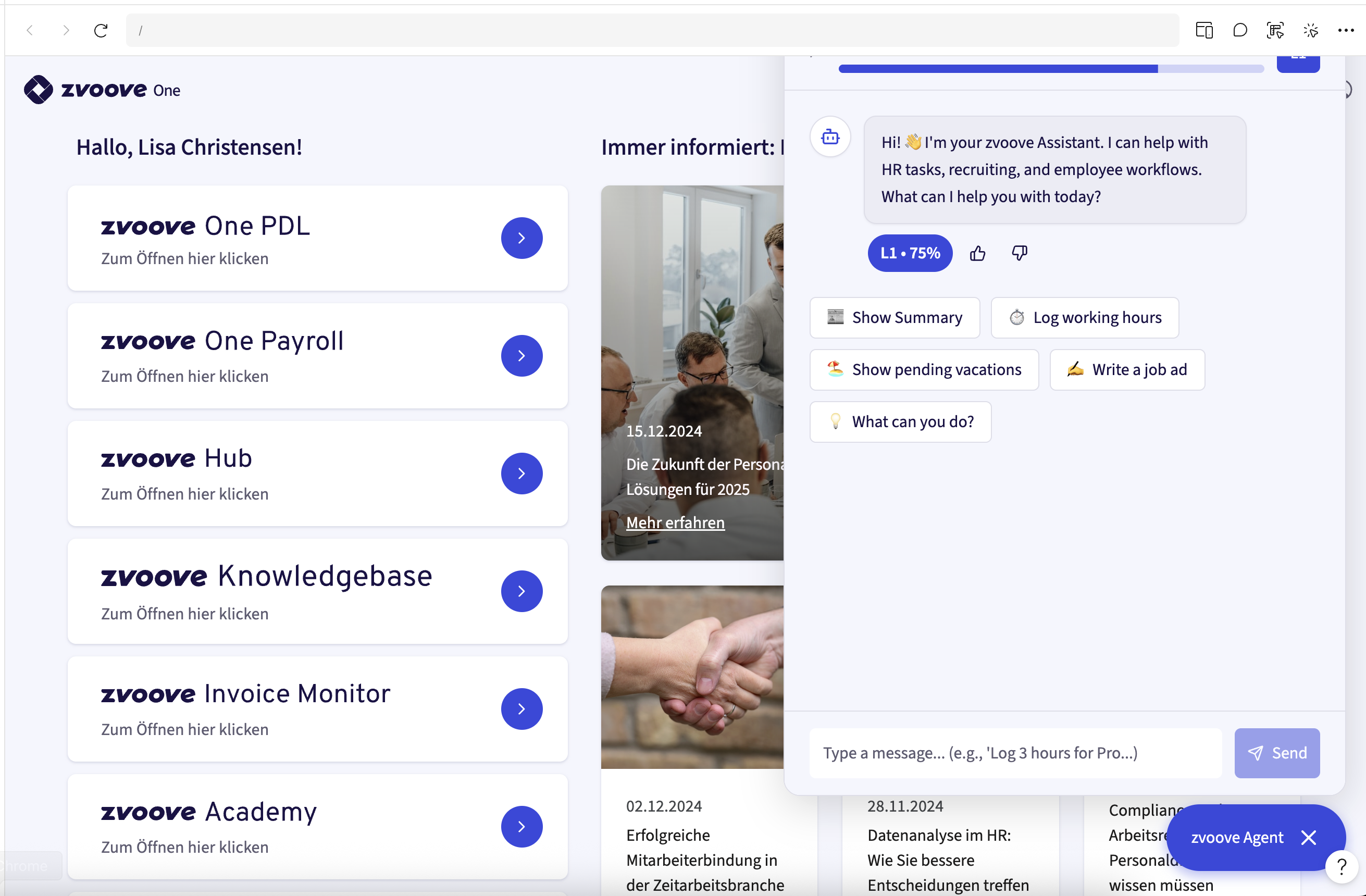
Behind it sat a level model: confidence decided which level answers, from a direct answer to a handover to support.
L0
System and context
Entry, orientation, setting expectations.
greeting, quick repliesL1
Known knowledge
Answers known topics directly.
confidence ≥ 0.8L2
Clarification
Resolves ambiguous input with a follow-up question.
confidence 0.5–0.8L3
Generative
AI-generated help with a disclaimer when confidence is low.
confidence 0.2–0.5L4
Handover
Handover to support or a human for unknown topics or repeated failures.
< 0.2 or 2–3 failures
Two things came of it later: the percentage left the interface in favour of interpretable uncertainty, and the chat got clearly separated jobs next to notifications and structured UI. The flagship case covers both.
The PM and I prioritised which cases zAIn had to handle first in around 20 qualitative interviews. In July 2026, customer tests at the innovation roundtable followed.
zAIn: this could become a powerful tool.
Every answer gets a form that fits it.
I designed the complete chat UI and UX: the thinking state, the messages and display patterns for the whole range of answers, from rich text through tables and cards to images and video.
Text
- How many orders are open in Cologne right now?A
- There are 12 orders open in Cologne, 3 of them start this week.
Table
- Who is available as a forklift driver next week?A
- Three employees match the request:
Available · forklift licence
J. Weber Forklift licence from Mon A. Yilmaz Forklift licence from Tue M. Nowak Forklift licence from Wed
Card
- Show me Jonas Weber’s current assignment.A
- Here is the assignment:
Assignment · Jonas Weber
- Customer
- Nordhafen Logistik GmbH
- Period
- 15–30 Sep 2026
- Shift
- Early, 6 am–2 pm
- Status
- confirmed
Open in the ERP
Video
- How do I create a new customer?A
- There is a short video from the zvoove Academy for that:
Create a new customer2:40
On top came confirmation and reflection cards, the prompting and the messaging script: how zAIn speaks and how it offers next steps.
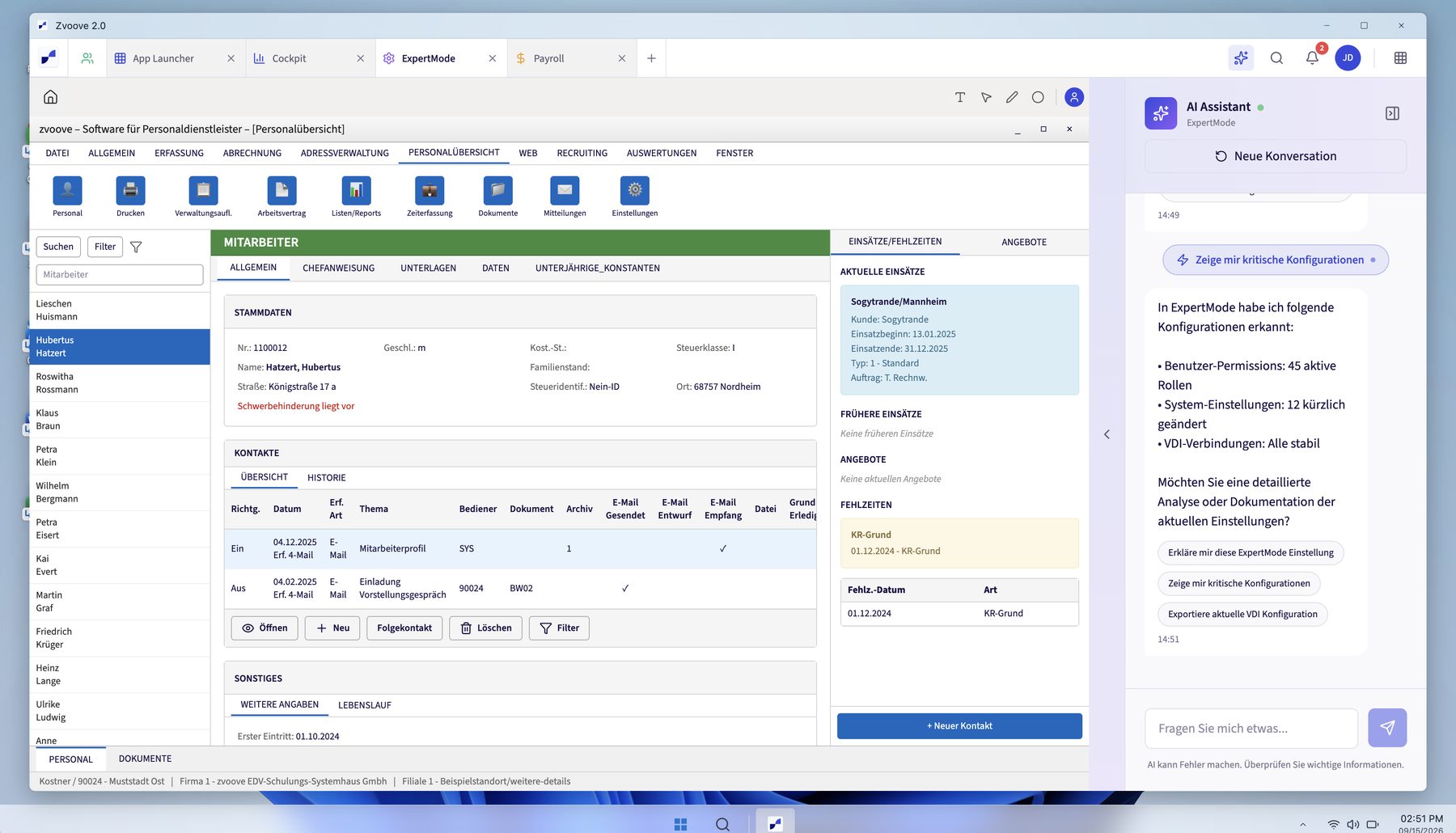
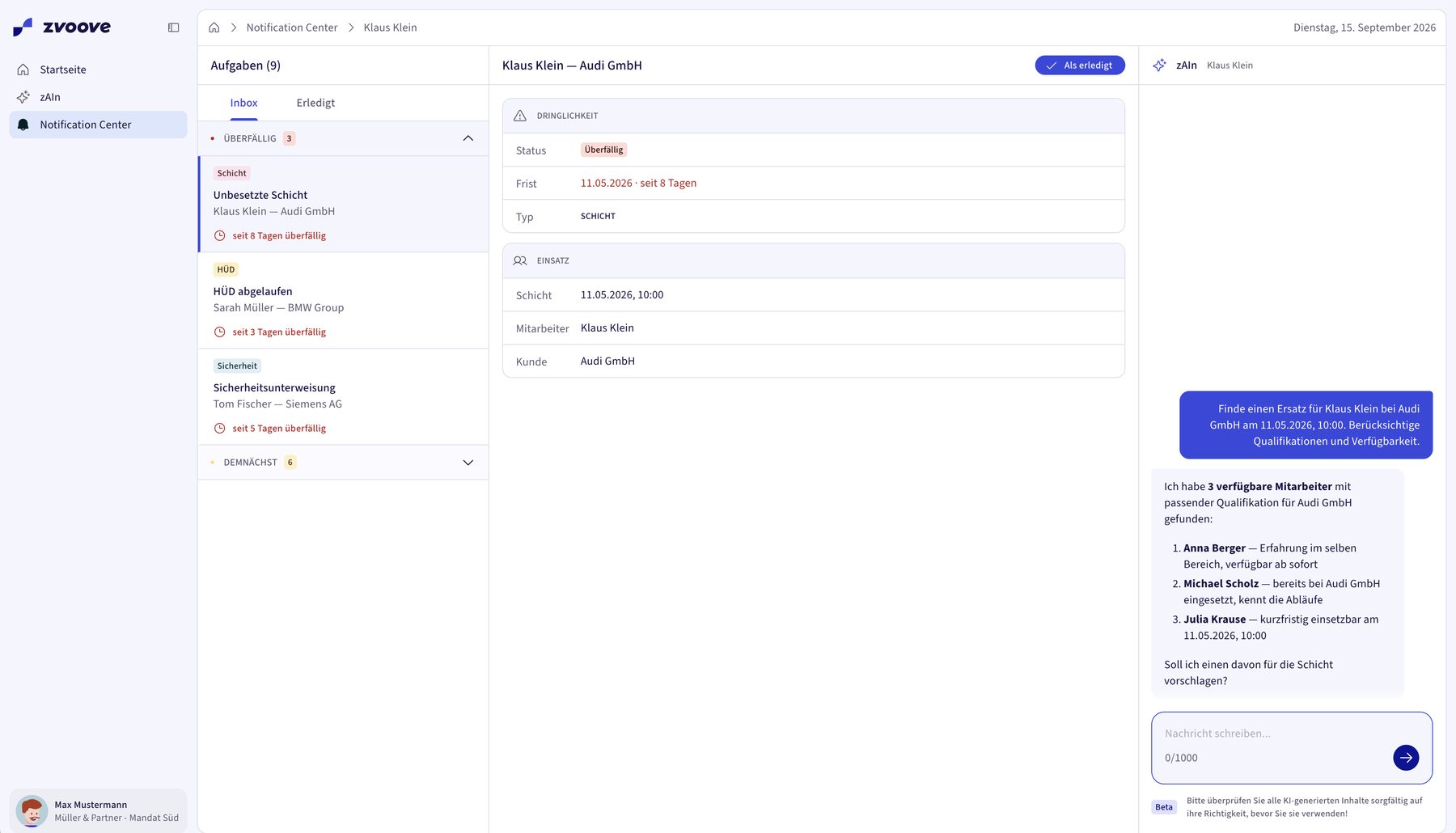
When zAIn is meant to act, the three-layer pattern separates what it understood, what it intends to do and what came out. Briefly in the flagship case, in depth in the UWX case.
Message
Understand
What zAIn understood becomes visible before it plans anything.
Intent
Plan
The steps are shown before they run; for write actions, approval sits here.
approvalResult
Result
The result stays attached to the case and traceable.
A handbook makes AI behaviour testable.
So that product, design, engineering and AI build the same behaviour, I set up the AI Assistant Handbook, an internal playbook (as of February 2026).
System
Hard limits no one overrides.
AI logic
How zAIn reasons and decides.
Interaction
Tone and structure of the conversation.
UI
The visible presentation.
Higher layers constrain lower ones: if the system blocks a request, the UI shows no “try anyway” button.
Every behaviour is written as a rule card: trigger, rule, rationale, example. If a dataset holds more than 500 items, for instance, it is not rendered in full. On top come patterns for recurring situations, such as ambiguity: two or three clear readings as a choice, more than three as a follow-up question. And a catalogue of edge cases, each mapped to its layers.
- Trigger
An input allows more than one reading.
- Rule
Two or three clear readings as a choice, more than three as a follow-up question.
- Example
Two readings, so a choice.
- Show me the open orders for Müller.A
- Do you mean one of these customers?Müller LogistikMüller Bau
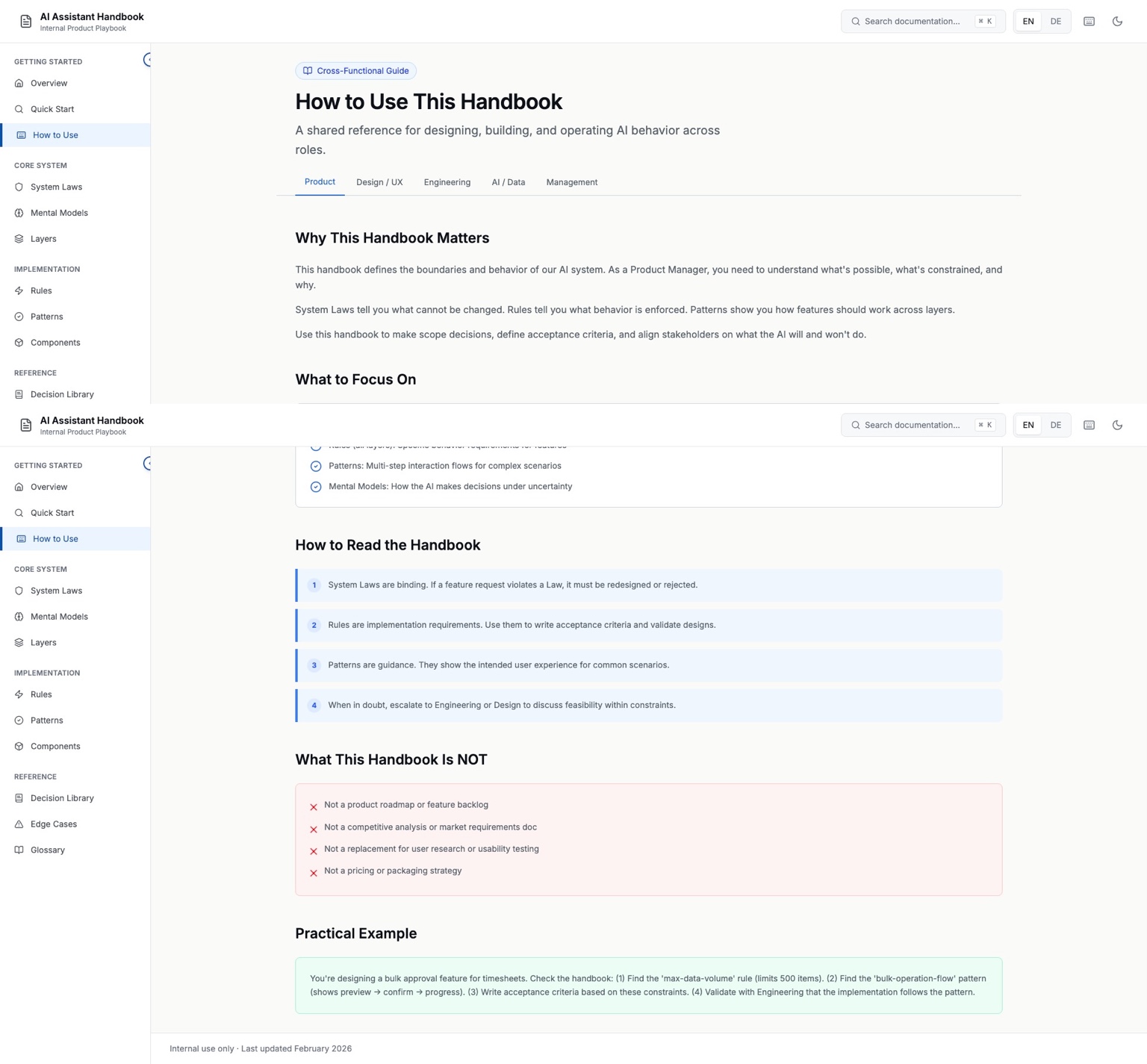
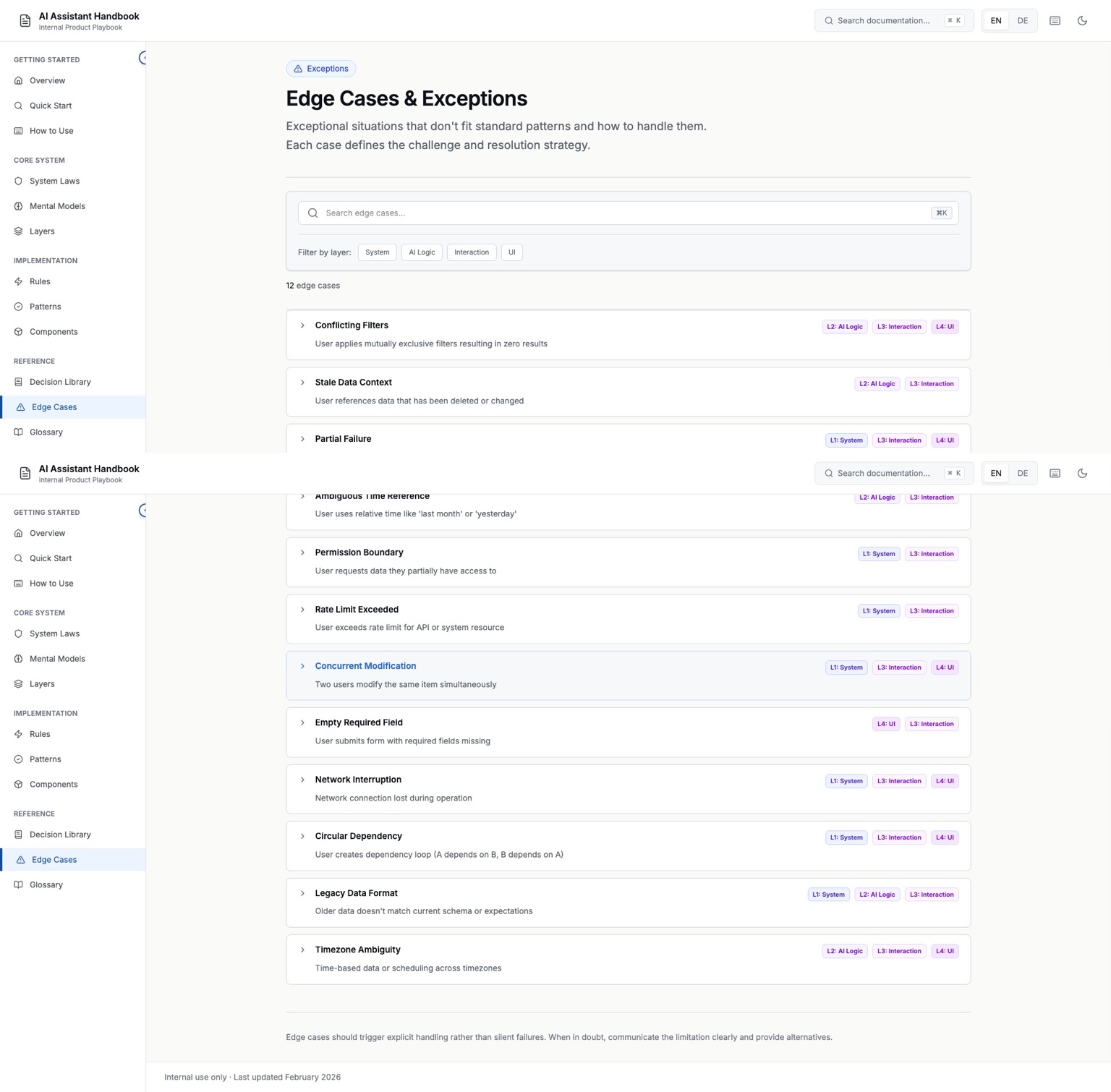
I built the AI Assistant Handbook on my own in Figma Make in February 2026; it became the AI Product Playbook.
Learning
A handbook for AI behaviour is a design system for decisions. It is meant to save the discussion that would otherwise start over in every feature.
What zAIn cannot do is designed.
At GA, zAIn reads only: 106 of the 154 classified endpoints are released, and write actions run on test and staging data only. The legal review for productive writes into the ERP is still open (as of September 2026).
Refuse honestly instead of hallucinating
v1 deliberately refuses analyses across the whole tenant, because without a search index the answers would be unchecked.
Sensitive data technically out of reach
Salaries, invoices, bank details and reasons for sickness are out of reach in v1, not just hidden. For this I built the three-layer pattern to GDPR rules.
Visibility over convenience
Queries across branches without an explicit visibility check were stopped in the test round.
- Which customer had the most assignment hours last quarter?A
- I cannot answer that reliably in this version yet: reports across the whole tenant need a search index that does not exist yet.
- I can show you the assignment hours for a single customer.Choose a customer
The limits follow the autonomy boundary: read before prepare before change.
Measured honestly after launch.
After go-live, the team and I analysed the conversations of the first weeks: recorded prompts, thumbs ratings and free-text feedback. We classified every prompt by whether zAIn answered, asked back or blocked.
What is live and what stays open
- Go-live, GA v1existing and new cloud customers
- 10 Aug 2026
- Endpoints released for readingof 154 classified
- 106
- First test roundAugust 2026
- 16 customers
What stays open
Write actions in the real system
Productive writes need the legal sign-off and the human gate in operation.
Analyses across the whole tenant
Need a search index before zAIn may answer them.
The fixable mechanics
The next iterations follow from the post-launch analysis.
fin (for now)