Product Design Case Study · Fintech
Making financial logic clear, limiting credit risk
Container xChange is a B2B marketplace for shipping containers. Its wallet brought together credits, income, invoices and credit limits, and every month 150–200 support requests came in about not understanding it. As Lead Designer, I reorganised the financial overview and connected payments to risk limits across two projects.
around 80%
fewer finance support requests
+72%
wallet payouts
Seven figures
recovered outstanding customer receivables, joint initiative
- Role
- Lead Designer, Financial Services
- Collaboration
- Product, Engineering, CFO, Account Management
- Projects
- Wallet 1.5 · Credit Limit
In short ~1 min
01 · Problem
150–200 requests a month
The wallet held credits, income, invoices and credit limits, and hardly anyone understood it.
02 · Intervention
Reordered, tied to risk
Wallet 1.5 reordered the financial overview, Credit Limit tied payments to risk limits.
03 · Outcome
Foundation for 2.0
Meant as a stopgap, Wallet 1.5 became the base for the next version.
Financial logic has to be readable. I ordered the wallet so customers understand it, and tied payments to risk limits.
xChange Financial Services
At a glance
−80%
finance support requests, the goal was −15%
−80%finance support requests, the goal was −15%Wallet 1.5+72%
wallet payouts, the goal was +20%
+72%wallet payouts, the goal was +20%Wallet 1.5Seven figures
recovered receivables
Seven figuresrecovered receivablesCredit Limit, a joint initiative
Problem
150–200 requests a month
The wallet held credits, income, invoices and credit limits, and hardly anyone understood it.
Intervention
Reordered, tied to risk
Wallet 1.5 reordered the financial overview, Credit Limit tied payments to risk limits.
Outcome
Foundation for 2.0
Meant as a stopgap, Wallet 1.5 became the base for the next version.
Making financial logic traceable
More than 20 interviews and hundreds of support calls showed the same pattern: users did not understand their invoices or the categories and statuses of their transactions. Balances and open amounts were hard to follow, and there were no direct payment actions.
The overview beside the details
A two-column system: a compact financial overview on the left, transaction details on the right. Invoices and statements have their own tabs, and explanation patterns show, for example, how the available payout is made up.
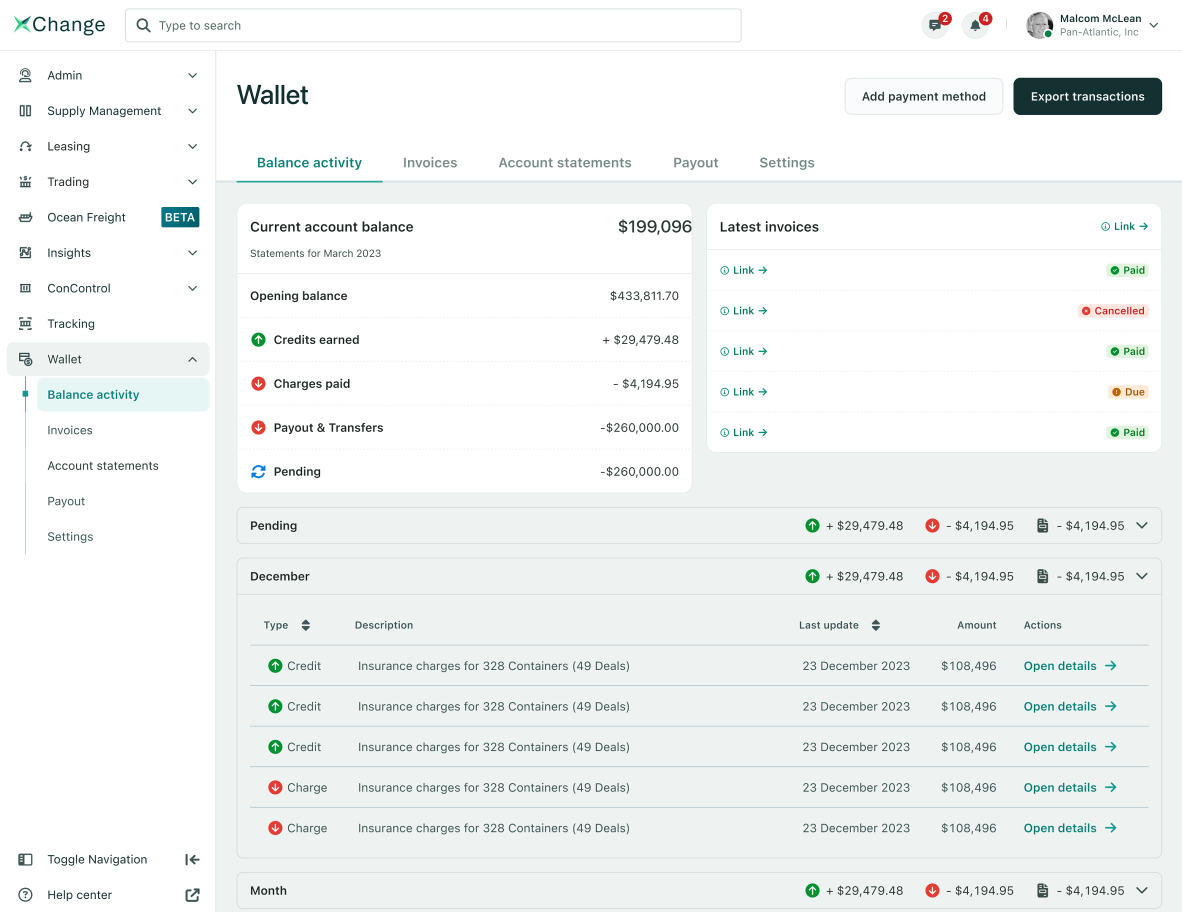
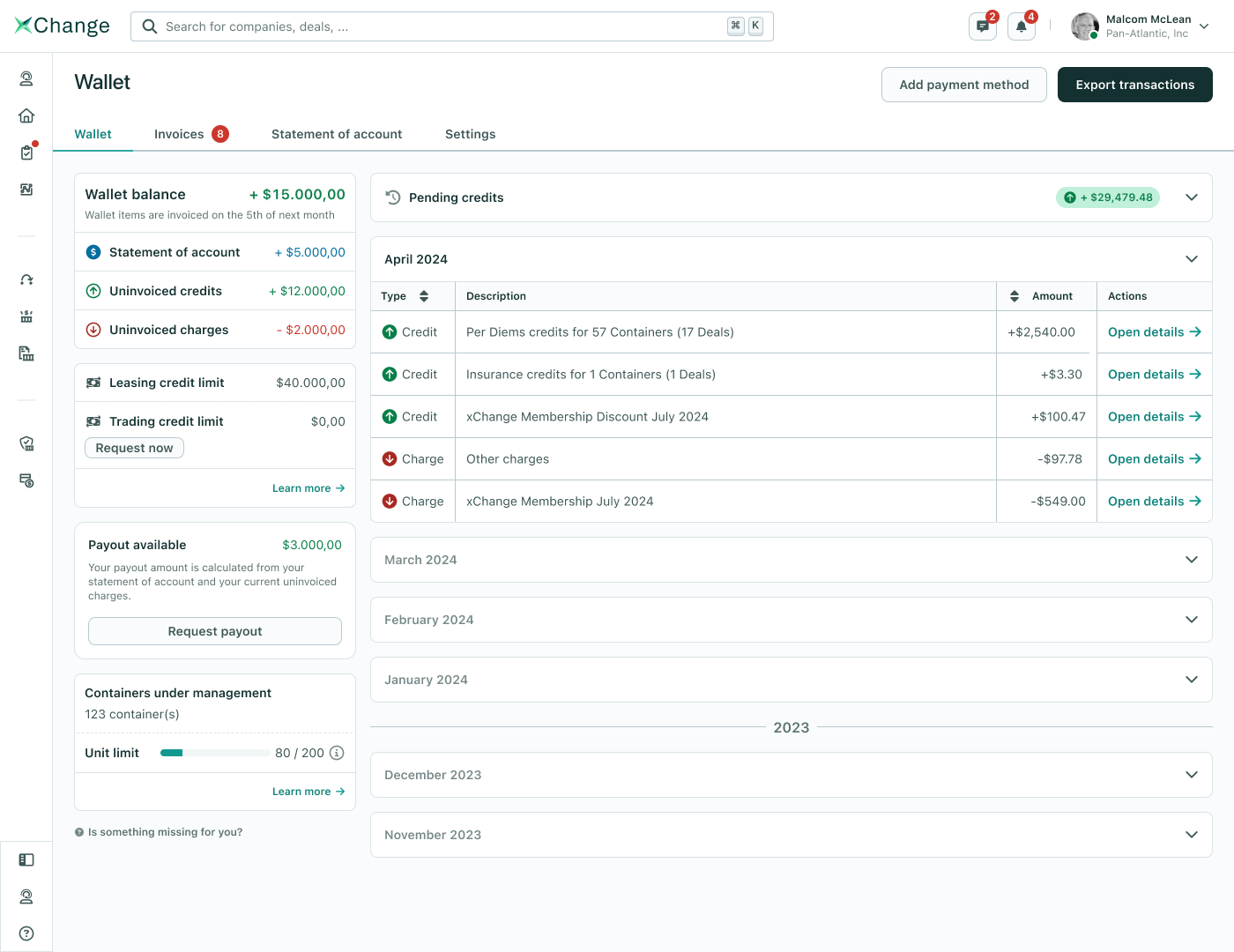
In the invoice table we deliberately accepted higher density: status, amounts, due date and deal reference sit together with the payment action, so everything needed to handle an invoice is in one place.
Wallet 1.5 went live in stages, built with shared UI components and tokens. We tracked support requests and feedback through Zendesk, DataDog and Account Management.
Outcome
- Finance support requestsGoal: −15%
- around −80%Goal exceeded
- Wallet payoutsGoal: +20%
- +72%Goal exceeded
Interviews also confirmed that users understood their credit limits better.
Connecting payments to risk limits
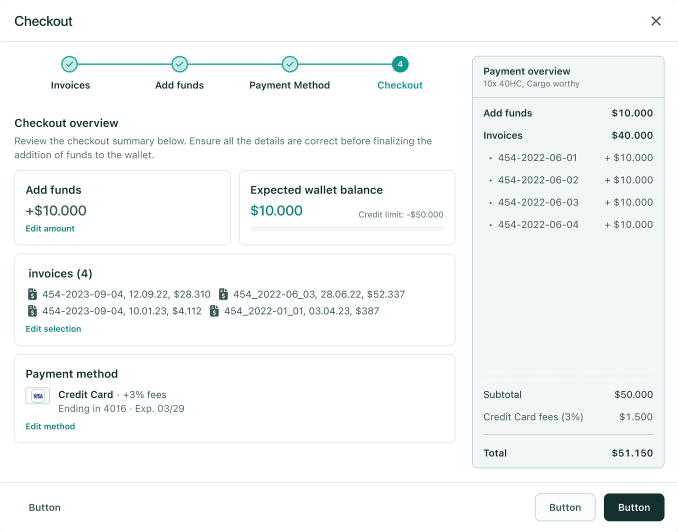
At the end of 2023, high negative customer balances became visible. Credit limits were poorly defined, and customers could exceed them before Operations could step in. I initiated the project and designed the payment flow and the warning logic.
For Credit Limit we were a team of seven: the PM, the tech lead, me in design and four developers; later the same team for all of Financial Services. When our PM was out, I carried the role for a while. The PM and I proposed the credit limits for the launch; the CFO and Account Management set them.
Level 1 · Notice
Dismissible. Points to open invoices and the credit limit.
Level 2 · Payment request
Stays in place, with restrictions until payment.
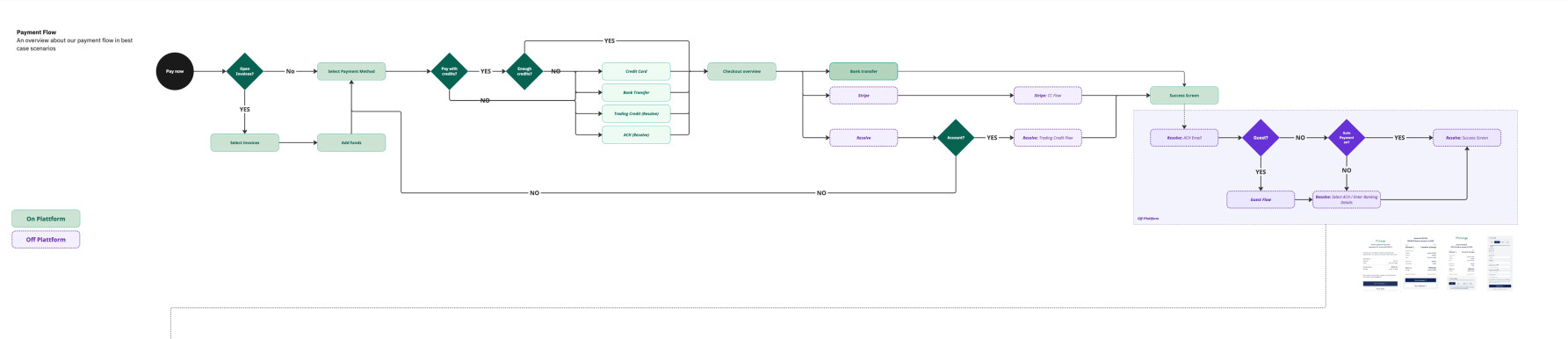
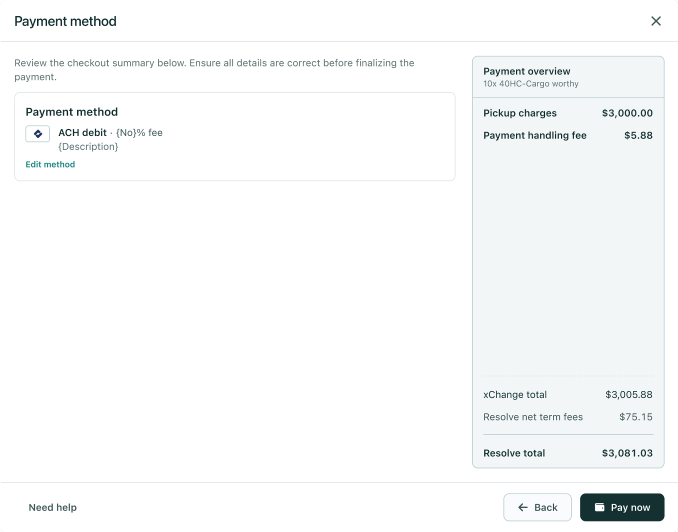
Outcome
- First solution liveTeam delivery
- 4 weeks
- Recovered outstanding receivablessix figures first, later
- seven figuresjoint initiative
What it achieved and what I would do differently
- Finance support requestsGoal: −15% · Wallet 1.5
- around −80%
- Wallet payoutsGoal: +20% · Wallet 1.5
- +72%
- Recovered receivablesCredit Limit · joint initiative
- seven figures
Wallet 1.5 was meant as a stopgap and became the foundation for 2.0. Credit Limit reduced financial risk quickly and created building blocks that carried further payment flows.
What I would do differently today
A smaller stakeholder group
Too many participants slowed Credit Limit down. A more selective group would have been faster.
Protect focus
Wallet 1.5 could have shipped in half the time. Side projects with higher priority stretched the plan.
Refine earlier
The first warning UI needed adjustments after launch to become clearer.